
Imagine you own 7,500 acres of forest in northern Sweden. You know roughly where your spruce stands are, you have a management plan last updated five years ago, and you have heard that bark beetle is moving north. You want a clearer picture of what is actually happening in your forest — and you have started reading about drones and satellites without getting much further than you started.
It is a situation that has become more common as airborne data collection has grown more accessible. And the question most people ask — drones or satellites? — is the wrong question. The right question is: what do you need to know, and how certain do you need to be?
Jacob Hjalmarsson, co-founder and CTO of Arboair, rarely answers directly when someone asks which technology they should use. He asks a question back: what will you do with the result?
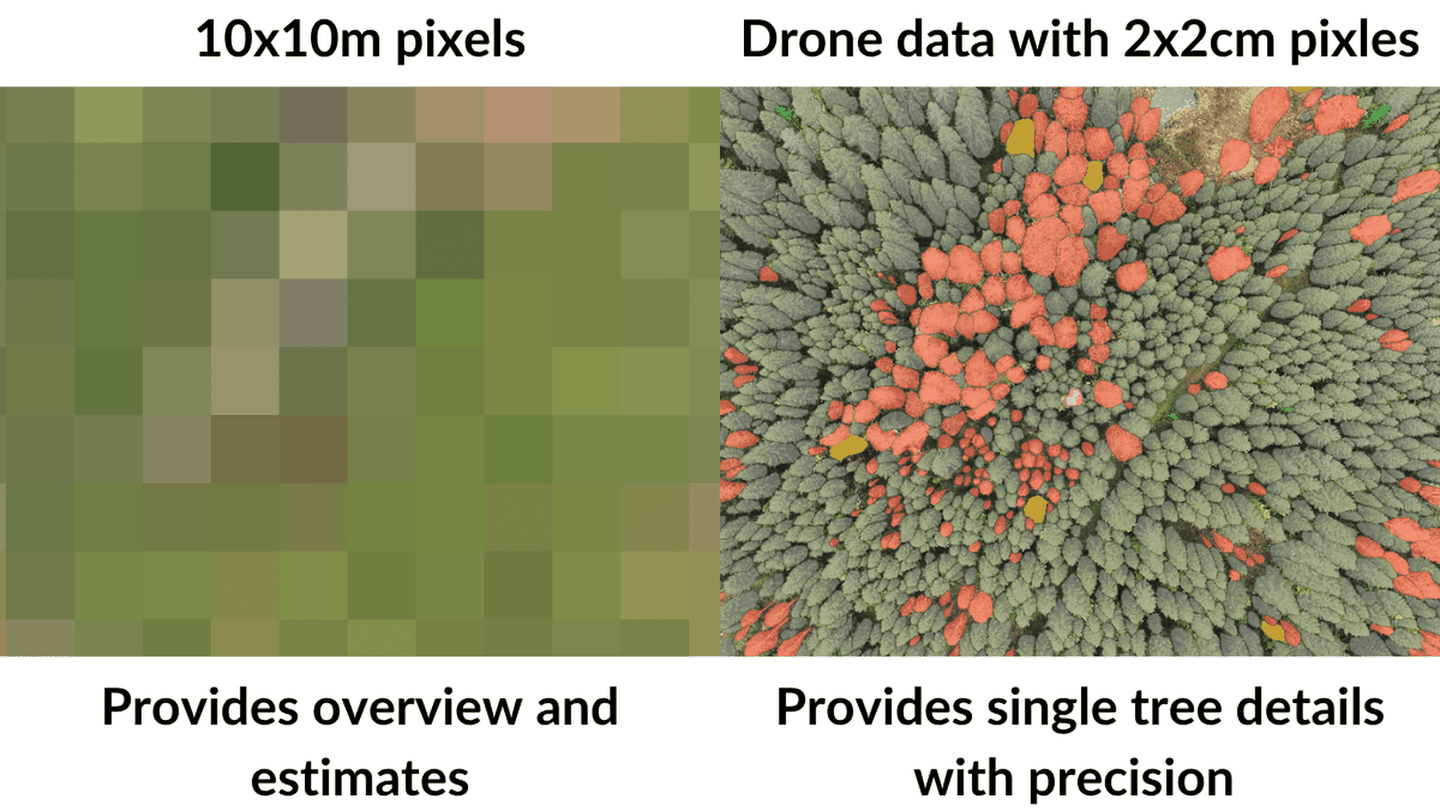
The answer to that question determines everything else, because the two technologies are fundamentally different in what they can deliver. Satellite is cheap and covers vast areas quickly — but it gives you estimates. Drones are more expensive and require more planning — but they give you facts.
That is not a value judgement. Estimates are excellent when you need a starting point. You do not need to know exactly which trees are infested with bark beetle if you simply want to figure out which of your three forest areas to prioritize for closer inspection. But when it is time to act — when you need to make a financial decision, plan a harvest, or sell a property — estimates are not enough.
The best commercially available satellite image today has a resolution of 15 centimeters per pixel. That sounds precise, but the reality is more complicated. That image is AI-processed from 30-centimeter data — the original image has been treated with so-called super resolution, a technique that interpolates sharpness that does not actually exist in the sensor. The best raw material a satellite actually collects is 30 centimeters per pixel.
Thirty centimeters per pixel is one hundred times lower resolution than a drone image.
That number can be hard to grasp intuitively, but it shows up clearly in the results. A standard rule in image analysis is that you need at least ten by ten pixels on an object to identify it with reasonable confidence. At 30-centimeter pixels, that means the smallest object you can see clearly is roughly nine square meters. Most fully grown trees with visible, extensive damage fall within that threshold. But a tree that is only partially affected often does not. A windthrow partially obscured by standing trees may appear as an irregularity in the canopy, but not as a measurable timber volume. And a healthy tree that happens to be in the shadow of its neighbor — depending on the angle of the sun when the image was taken — can appear in the satellite image as a dark patch rather than a living tree.
Add to that the atmospheric interference that is always present in satellite data, and the risk that cloud cover renders an entire image unusable.
There is also a structural limitation that rarely gets mentioned in the sales pitch: satellite images are two-dimensional. They capture the surface, but give no information about height or three-dimensional structure. Height data must be sourced elsewhere — in Sweden, the Swedish Mapping Authority's open LiDAR data is commonly used — and combining multiple data sources, each with their own error margins, introduces uncertainties that compound rather than cancel out.
That combination is nonetheless what has made satellite-based estimates useful. Companies like Collective Crunch and TerraLabs have shown that it is possible to build estimation products that outperform the Swedish University of Agricultural Sciences' Skogliga Grunddata — the system underlying most automated forest management plans in Sweden today — by combining satellite imagery, historical measurements, and machine learning models. But it is still estimation. Better estimation, but estimation.
The practical consequence of the resolution gap shows up most clearly in damage surveys. When Arboair supplements a satellite-based damage assessment with drone flights, the drone data consistently finds more than 40 percent more damage.
That is not a small discrepancy. It is the difference between believing you have a manageable problem and understanding that you have a serious one. For a forest owner calculating their finances, planning their harvests, or negotiating with an insurer, that gap can be decisive.
The type of damage satellite handles reasonably well is large-scale, contiguous damage — stands that have been completely flattened by a storm and show up as brown patches against the green. That is precisely what appears in the Swedish Forestry Agency's satellite-based risk maps for bark beetle and windthrow, and it is a genuinely useful function. But individual infested trees, scattered windfalls, and early-stage bark beetle attacks — the things that determine whether a damage event spreads or stops — those require drone resolution.
A satellite image covering 6,200 acres in the mid-resolution range costs between roughly 1,000 and 1,500 US dollars. Lower resolution can cost half that. The Swedish Forestry Agency's maps are free.
A professional drone survey of the same area takes five to eight working days. Pilot costs run between 75 and 125 dollars per hour depending on equipment and operator — a total outlay in the range of 3,000 to 8,000 dollars for flight time alone, before image processing and analysis.
That is a substantial difference in absolute terms. But it is also the wrong way to compare them.
The satellite's cost buys you a basis for navigation. The drone's cost buys you decision support you can act on without hesitation. In a property transaction, a generational transfer, or a damaged forest, the difference in factual value can far exceed the difference in data collection cost. A forest owner who sells a stand based on a five-year-old management plan and a satellite estimate frequently leaves money on the table that a drone-based analysis would have put back in view.
Satellites orbit the earth every day, but that does not guarantee access to usable images. In northern Scandinavia, the period from November through February is effectively unusable for new image collection — the combination of persistent cloud cover and low solar angle makes the raw material too poor to work with. The best conditions exist between April and September.
That is why most commercial estimation products are built on historical data. Providers know their customers cannot wait for a clear spell in November, so they build their products from archive images accumulated over recent seasons. That ensures availability — but at the cost of timeliness.
Drones stop for rain and strong wind, but they are not constrained by solar angle or season. During a high-pressure window in February, it is entirely possible to fly and collect data that satellite simply cannot deliver for the same period in northern Sweden. That operational flexibility is an underappreciated advantage — particularly when damage or a business opportunity does not fit neatly into the summer season.
For those managing tens of thousands of acres, the answer is not to choose one technology and exclude the other. The rational approach looks roughly like this.
The foundation of the management plan — the basis on which cash flow analyses, action plans, and investment decisions rest — is best built on drone data. That creates a factual baseline that holds over time. Satellite-based services then take over for ongoing monitoring: they identify hotspots, flag anomalous patterns, and help managers prioritize where to direct resources. When a satellite map points to a risk area, the drone goes in to confirm what is actually there, quantify the damage, and provide the basis for a concrete decision.
Satellite for prioritizing, drone for acting.
Arboair supports both approaches. As a Solutions Partner to EUSI, Arboair analyses satellite imagery for large-scale damage mapping across large holdings at lower cost — an entry point that helps forest owners quickly understand where problems exist. Drone analysis through ArboPortal takes over when it is time to know.
It is tempting to assume that better satellites will eventually close the resolution gap and make drone data redundant. But the quality of satellite imagery is not limited only by what engineers can build — it is limited by regulation and geopolitics. There are international agreements governing how close to earth's surface commercial satellites may orbit, and those conversations do not move at the pace of technology. The fundamental principle — that a sensor hundreds of miles up in the atmosphere sees the world differently from a camera at 400 feet — is likely to hold for a long time.
The drone operates at a few hundred meters of altitude. It sees the tree, not the stand.
Back to the forest owner in northern Sweden with their 7,500 acres and their concern about bark beetle: the smartest first step is to use the satellite-based maps already available to get a rough picture of where the risk is greatest. Then fly those areas with a drone. Not because satellite is bad — but because estimates are a good way to decide where to look, and facts are the only way to decide what to do.
Get an overview first. Prioritize the actions that matter. Fly them with a drone — to know that you have the right information, make the right decisions, and get paid what your forest is actually worth.